Why Gluto.ai exists, and how it works — the six hours behind one safe meal in Detroit
The trip is booked. Two nights in Detroit — a concert on Saturday, a flight home Sunday evening. Your friends are already sending links: the Detroit-style pizza place everyone talks about, the brunch spot with the line around the block, a bar near the venue.
They are planning. You are doing something else entirely. You open a browser, and then a second window, and then a notes file. Because before you can be excited about Detroit, you have to answer a question they will never have to ask:
“Where, in this city I have never been to, can I eat two days of meals without ending up sick?”
We are going to answer it the hard way first — the real blogs, the real Reddit threads, the real Facebook group that any celiac traveler lands on — and count the hours honestly. Then, in the second half, we will show you exactly what Gluto's agents do with that same raw material, and why it took a machine that can actually read to finally make this tractable.
Detroit is only the example. Swap in Lisbon, Austin or Osaka and the shape of the problem is identical — which is exactly why it needed solving once, properly, rather than re-solved by every traveler in every city.
First, the one percent you may never have met
You might not know anyone with celiac disease. Statistically, you almost certainly do — you just have not had the conversation.
Roughly 1 in 100 people worldwide have celiac disease
That is about one percent of the planet. In the United States alone it works out to a few million people, and research consistently suggests a large share of them are still undiagnosed — walking around with symptoms nobody has connected yet. Add non-celiac gluten sensitivity and wheat allergy and the group gets meaningfully larger.
Here is the part that gets lost when “gluten-free” shows up on a menu next to “keto” and “low-carb.” Celiac disease is not a preference, a trend, or a sensitivity you can push through on a special occasion. It is an autoimmune condition: eating gluten makes the immune system attack the lining of the small intestine. There is no pill. There is no enzyme you can take before dinner and be fine. The only treatment medicine currently offers is to avoid gluten completely, for life.
And “completely” is stricter than most people imagine:
- A crumb is a dose. Studies on gluten thresholds suggest that on the order of 50 milligrams a day — visually, a crumb of bread — is enough to cause measurable intestinal damage in people with celiac disease.
- The damage can be silent. Plenty of people have no dramatic reaction and still sustain injury. “I felt fine afterward” is not evidence that the meal was safe.
- The risk is rarely the dish. It is the shared fryer, the same tongs, the pasta water, the flour in the air, the pizza cutter, the toaster the gluten-free bun goes into.
- Labels do not survive the kitchen. One widely reported study that used portable gluten sensors on restaurant food found that a substantial share of items sold as gluten-free — with pizza and pasta among the worst — still had detectable gluten.
So the question “is this restaurant safe?” is not really a question about the menu. It is a question about a kitchen you cannot see, staffed by people you have never met, on a night nobody has reported on yet. There is no public registry for it. Health inspectors do not grade cross-contact. No official body in any city keeps a scored, current list of which restaurants can genuinely feed a celiac.
A real medical need, affecting one in a hundred people, and no institution on earth had built the map. So the patients built it themselves.
When nobody builds the map, you build it yourself
This is the part of the story we find genuinely moving, and it is the reason Gluto exists at all.
Faced with a need that no company and no health system was serving, the celiac community did what communities do. Somebody started a blog and wrote up every restaurant they ate at. Somebody else answered a stranger's question on Reddit at eleven at night. A mother in the suburbs started a local Facebook group and it grew to thousands of members. A traveler filmed a ninety-second reel of a bakery case. A person who got sick wrote a one-star review specifically so the next celiac would not order the same thing.
Nobody was paid for most of it. There was no editor, no schema, no standard. Each person contributed one small fragment of the truth — one meal, one phone call, one photo, one honest comment — and the votes, likes and replies did a rough, informal kind of peer review on top.
Over years, that added up to something remarkable: a vast, real, hard-won body of knowledge about which kitchens in which cities can be trusted. It is one of the great uncredited crowdsourcing projects on the internet.
It is also, from the point of view of a person landing in Detroit on Friday night, almost impossible to use.
So let's actually do it. Dinner in Detroit.
Here is what happens when you sit down and start searching, for real. Every screenshot below is a genuine result — the same handful of pages any celiac traveler lands on within about ninety seconds of typing “gluten free Detroit.”
Source one — the Michigander who has been doing this since 2012
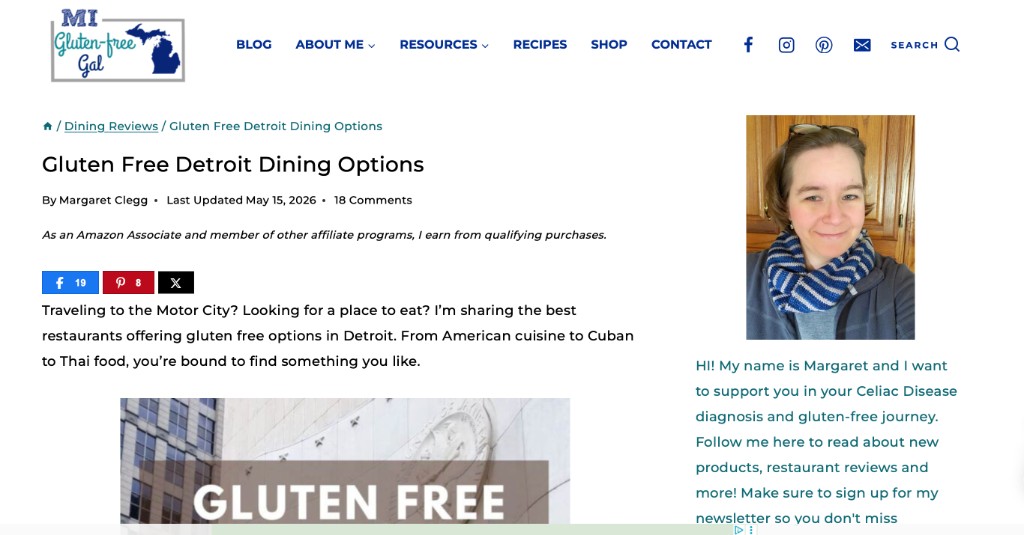
This is the good stuff. Margaret has celiac disease herself, she has been writing about Michigan since 2012, she lives there, and the post was updated this year. She goes further than most: she separates the one hundred percent gluten-free kitchens from the ones that merely offer options, she writes a Cross Contact Prevention Protocols section for every single restaurant, and she marks with an asterisk the places she has not personally eaten at.
And when she gets a real answer, it is worth more than any listicle. On Frita Detroit she quotes the owner directly: a dedicated fryer, a zipped bag holding a dedicated gluten-free cutting board, knife, pot and pan, and — for celiac orders specifically — a note on the ticket, a verbal call to the expeditor, the order written on a whiteboard, and one dedicated person preparing and packaging it from start to finish. That is the level of detail you would otherwise only get by calling yourself.
She is also honest about what she does not know yet. Under Buddy's Pizza: “In the past, Buddy's restaurants maintain a separate gluten free prep space… I am emailing them to confirm that this is still true.” Under Slow's BBQ: “I have emailed the restaurant asking for further information. When they answer my questions, I will update this space.” Those are open questions, sitting unresolved on the page, and they happen to be about two of the most famous restaurants in the city.
You have struck gold on your first search. You also have exactly one page, written by one person, in a format built for reading — not for filtering by “open Saturday after the show, within a mile of my hotel, with a dedicated fryer.” And some of the best intelligence on the page is not in the article at all. It is in the eighteen comments underneath, where a reader mentions eating gluten-free pizza at the Brass Rail at every Lions home game for two years, and another names a breakfast place in Madison Heights she found through an app. Nobody is going to find that with a search engine.
Source two — the celiac travel writer
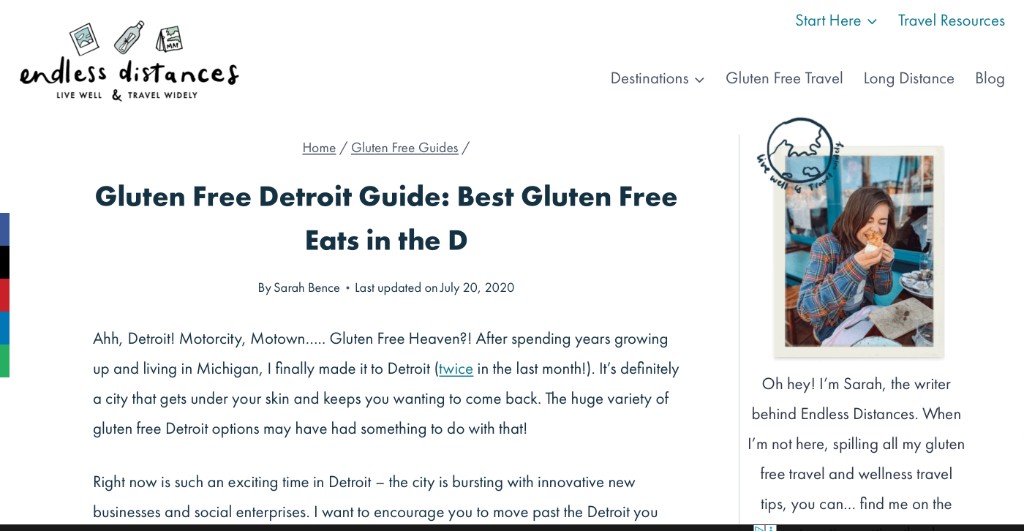
Also excellent, and from a completely different angle. Sarah has celiac disease, grew up in Michigan, and states her evidence standard up front: “We've eaten at every one of the following restaurants and had a good experience and I had no reaction.” Then she documents the mechanics. A separate kitchen prep area and separate pots and pans at Hudson Cafe. A waffle iron at FOLK used solely for gluten-free waffles. Foil-lined pans, glove changes and the top oven shelf at Buddy's. At Seva she noticed a confusing note about the fryer on the menu, cross-examined the waitress about it, and reported back what she learned.
She even keeps a separate list at the bottom of places she has not been, with a line in bold: “I cannot recommend any of these following restaurants based on my own experience, or ensure safe procedures at any of them.”
Now look under the title. Last updated on July 20, 2020.
Six years. In restaurant time, that is a geological era. Chefs move on, owners sell, the manager who trained everyone on allergen protocol takes a job across town, the dedicated fryer gets repurposed on a busy Saturday, the place closes entirely. The guide is not wrong, exactly. It is of unknown current truth, and there is no way to tell from the page which parts still hold — which is a strange fate for writing this careful.
Source three — the city itself
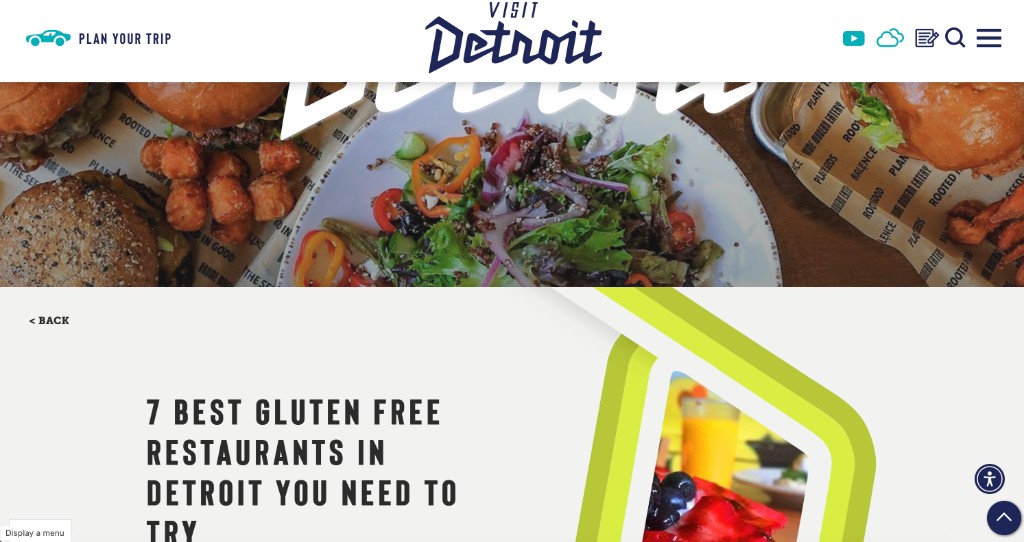
This one feels different. It is the official tourism board. Big photography, confident headline, institutional authority. After two personal blogs, it reads like corroboration — a third, independent voice naming some of the same restaurants.
Then you scroll to the byline. Story by Sarah Bence.
It is the same author as source two. Your “independent confirmation” was the same celiac traveler, writing for a different masthead.
And the two pages are connected at the root. Scroll to the very bottom of her personal guide, past the map and the Pinterest image, and there is a line in small italics: “We were hosted in Detroit by Visit Detroit… We paid for our meals at all restaurants independently, apart from FOLK… All opinions are my own and I would never share a restaurant I did not feel comfortable recommending to other people who are celiac/gluten free.”
She disclosed it, clearly and voluntarily, which is exactly what a trustworthy writer does. That is the point. The information you need in order to weigh the source correctly was published — at the bottom of a long page, in italics, below a Pinterest graphic, six years ago. Being a careful reader means finding it, reading it, and adjusting. Doing that for every source, for every restaurant, for every meal, is the job.
None of this is a criticism of anyone; the city was smart to commission someone who actually lives this. But it tells you something structural about the shape of this information: the pool of people doing the real work is far smaller than the number of pages that quote them. If you are not reading bylines and disclosures, you will badly overestimate how much your sources independently agree.
This is the first real trap. Cross-checking only means something if the sources are genuinely independent. Three pages naming the same restaurant can easily be one person, one press release, or one popular Reddit comment echoing through the internet.
Source four — strangers who answered kindly
So you go where the unvarnished answers are, and search Reddit.
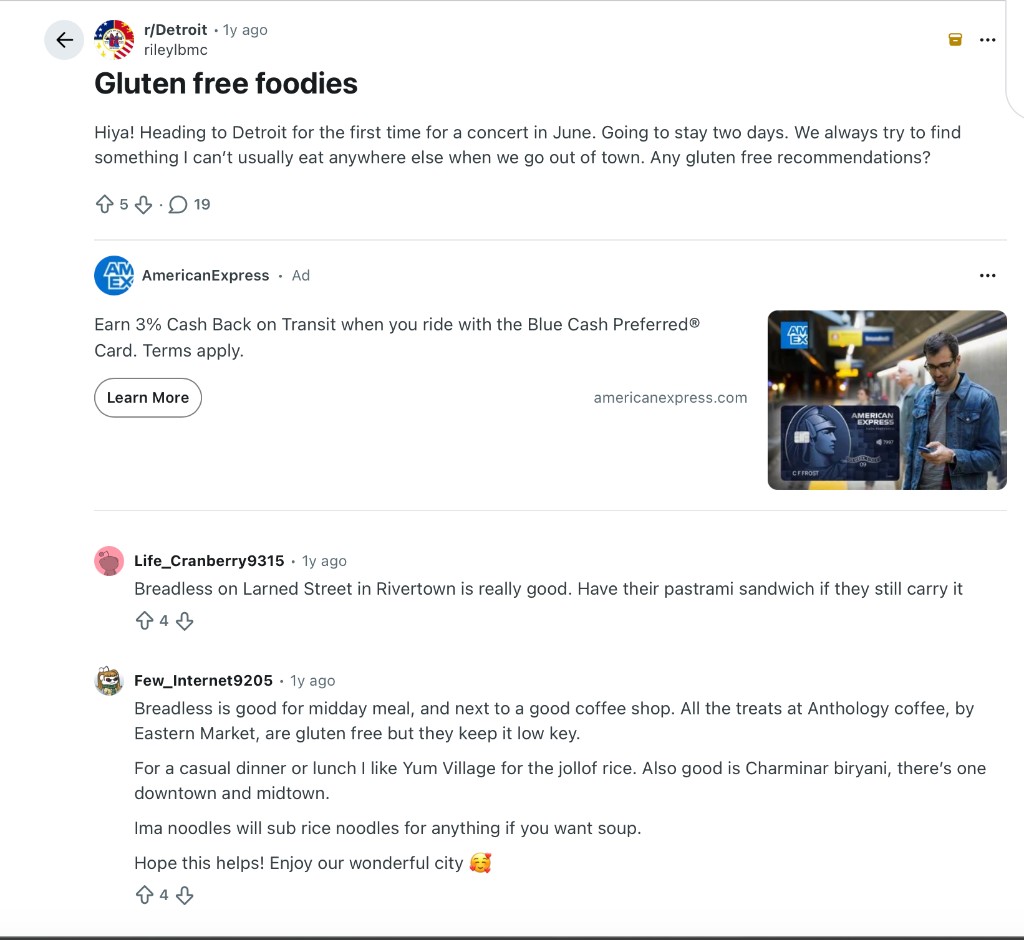
Look at the quality of this. A stranger going to a concert asks a question, and locals show up with specifics: the pastrami sandwich at Breadless, the treats at Anthology by Eastern Market that “are all gluten free but they keep it low key,” the jollof rice at Yum Village, biryani at Charminar, the noodle place that will swap in rice noodles for anything. It ends with “Hope this helps! Enjoy our wonderful city.”
Nobody was paid to write that. It is the community at its absolute best. Keep scrolling and you find more.
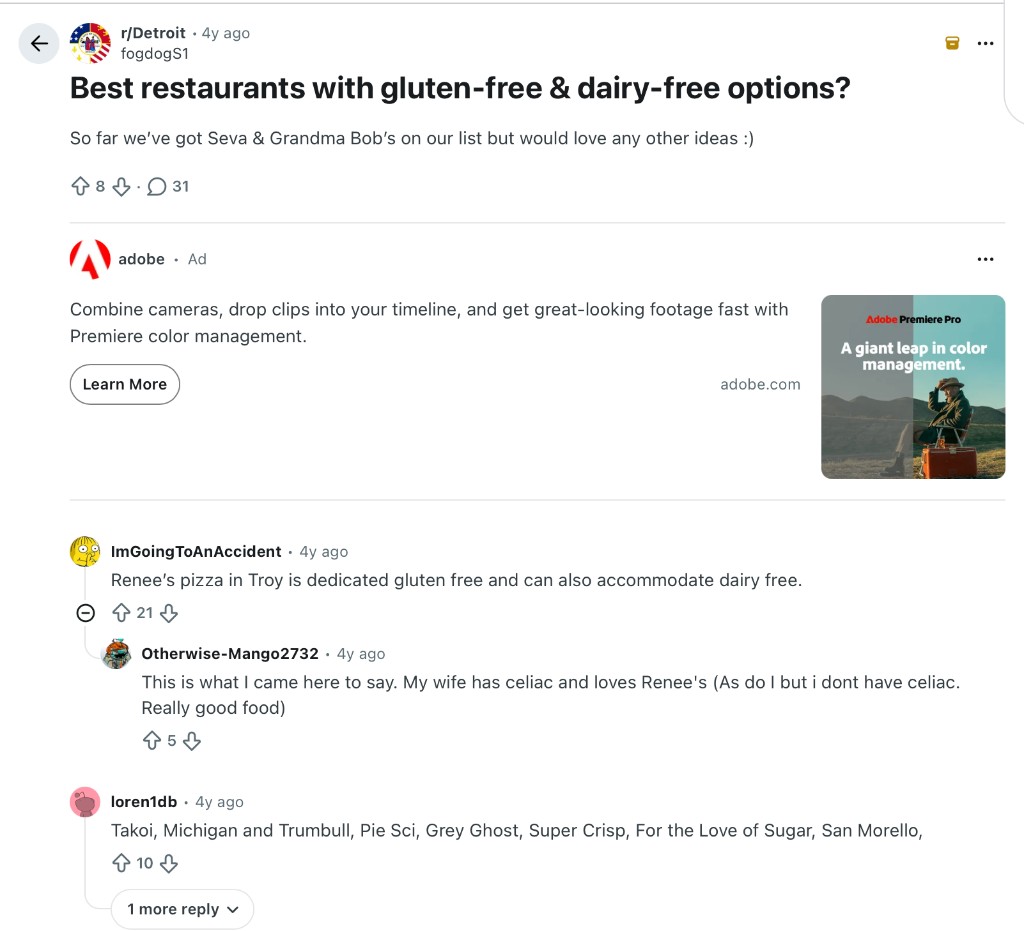
Twenty-one upvotes on “Renee's pizza in Troy is dedicated gluten free.” A reply underneath: “My wife has celiac and loves Renee's.” That is a strong signal — a dedicated facility means the structural risk is gone rather than merely managed. Then the very next comment lists eight more restaurant names with no detail at all, and you have no idea whether the person writing it has celiac disease or simply orders gluten-free sometimes. Those two things look identical on the screen and mean completely different things for your Saturday.
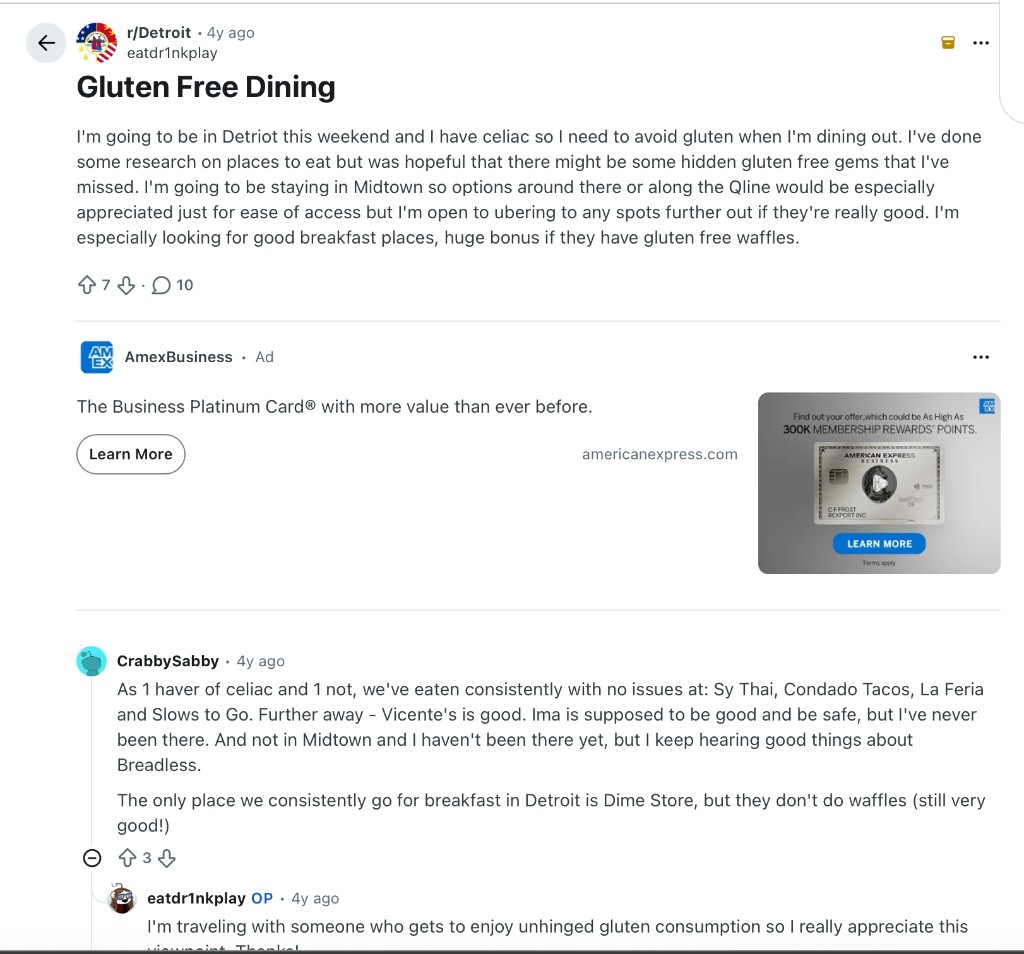
This last one is worth reading closely, because it shows how much interpretive work the reader has to do. The commenter writes: “As 1 haver of celiac and 1 not, we've eaten consistently with no issues at: Sy Thai, Condado Tacos, La Feria and Slows to Go.” That is a genuinely high-quality data point — a celiac person, repeat visits, no reaction.
And then, in the same paragraph: “Ima is supposed to be good and be safe, but I've never been there.” Honest, and completely different in weight. One sentence is first-hand evidence. The next is a rumor, flagged as a rumor. They sit next to each other in the same comment, in the same font, and it is entirely on you to separate them.
Multiply that by every comment in every thread. This is the actual cognitive labor of celiac travel: not finding information, but continuously grading it.
Source five — Instagram and TikTok
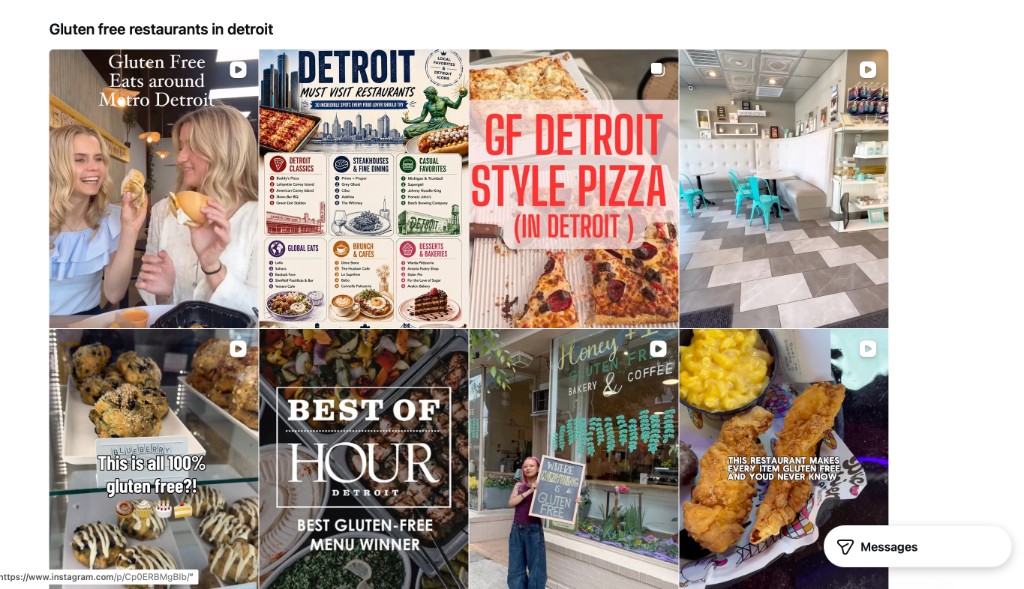
Now you get the thing text can never give you: the actual bakery case, the actual pizza, a person walking through the actual door. Creators here are often the fastest to know when a new dedicated bakery opens, and video is unusually good evidence — you can sometimes see the separate prep station with your own eyes.
But this is the least tractable source of all. You cannot filter it. You cannot sort by date, and a reel from three years ago looks exactly like one from last week. Some posts are sponsored and some are not, and the label is not always obvious. The good information is trapped inside video, where no amount of scrolling gives you a list you can act on.
Source six — the private Facebook group
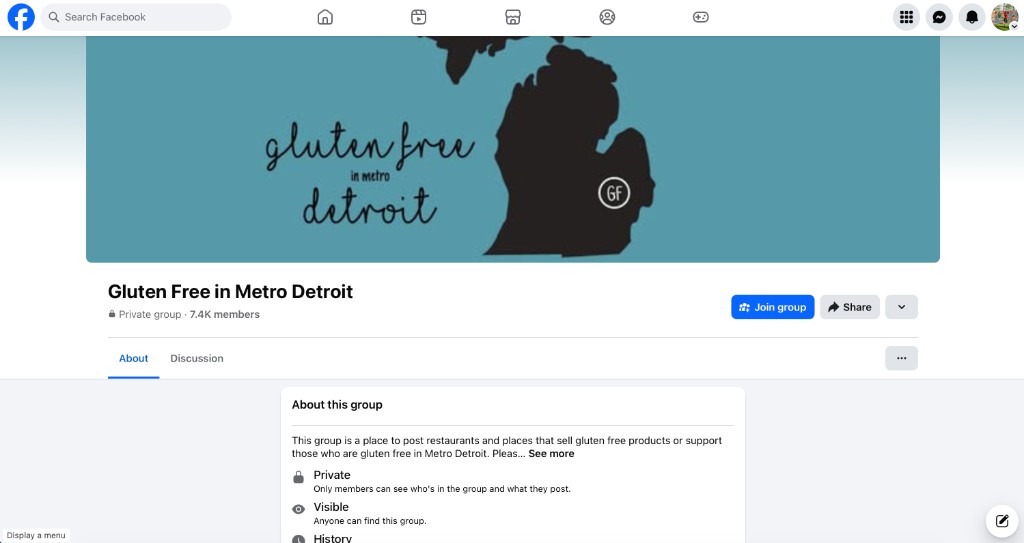
Seven thousand four hundred local people, many of them celiac, many of them parents of celiac kids, all posting about exactly the thing you need to know. This is very likely the single best source of Detroit gluten-free intelligence in existence. Someone in there ate at your shortlist restaurant last week.
It is also private. You request to join, and then you wait — hours, sometimes days, for a moderator who is a volunteer with a job. If you are approved before your trip, you land in a reverse-chronological feed with a search box that was never designed for research, and you start scrolling through years of posts hoping the right one surfaces. Every city has one of these. Each is a separate walled garden with its own queue.
A worked example: your safest option is filed under a name it no longer uses
Let's follow a single restaurant through everything we just collected, because it shows the whole problem in miniature.
One place keeps surfacing as the strongest candidate in the entire pile: a one hundred percent gluten-free pizzeria in Troy. For a celiac traveler that is the highest-value fact available anywhere, because a dedicated kitchen removes the risk structurally instead of managing it procedurally. There is no shared fryer to ask about. Here is how your sources describe it.
| Source | Date | Name used | What it tells you |
|---|---|---|---|
| Endless Distances guide | July 2020 | Renee’s Pizzeria | “100% gluten free pizzeria in Troy outside Detroit” — listed among places she has not personally visited |
| Visit Detroit | No date shown | Renee’s Gourmet Pizzeria | “One of the few 100 percent gluten free restaurants in the Detroit area” |
| r/Detroit thread | ~4 years ago | Renee’s | “Dedicated gluten free and can also accommodate dairy free” — 21 upvotes, plus “my wife has celiac and loves Renee’s” |
| MI Gluten Free Gal | Updated 2026 | Tru Pizza (formerly Renee’s Gourmet Pizzeria) | 100% gluten free, Troy |
Three of your four sources call it Renee's. One — the only recently updated one — quietly tells you the name changed, in a parenthesis.
And if you want that rename confirmed, you have to scroll past the article and through seventeen other comments to find a reader named Patricia recommending “Renee's Gourmet Pizza in Troy,” and Margaret replying underneath: “yes, it's on the list. It's been renamed Tru Pizza.” That exchange is from November 2022. It has been sitting in a comment thread for nearly four years, and it is the only place the two names are explicitly reconciled.
So picture the version of you that did the research slightly less obsessively. You cross-referenced properly. Three independent-looking sources agreed. You searched for Renee's, found a dead listing or nothing at all, concluded it had closed like so many restaurants did, and crossed the single safest option in metro Detroit off your list — while it was open the whole time under a different sign.
This is what “the information exists, nobody assembled it” means in practice. Nothing was missing. Every fact was published: the dedicated kitchen, the celiac spouse who loves it, the rename, the current name. They were simply spread across four platforms, three of them stale, with the one piece that reconciles them buried in a four-year-old blog comment. No human doing this by hand at eleven at night is guaranteed to catch that. This is precisely the kind of reconciliation a machine should be doing for you.
Forty tabs later, you still don't have a plan
Take stock of what you are holding now. Somewhere between fifteen and forty open tabs. Two blog posts, one of them six years old. A tourism page that turned out to share an author with one of the blogs. Three Reddit threads spanning four years. A grid of videos. A pending group membership request.
Inside all of that: maybe thirty restaurant names — and, as we just saw, at least one of them is the same kitchen listed twice under two different names. Some appear once. Some appear four times, which may or may not mean four independent people. A few are fully dedicated gluten-free kitchens. Most are described as “has gluten-free options,” a phrase that spans everything from Frita's whiteboard-and-dedicated-fryer protocol to a server saying the salad is probably fine. Two of the biggest names in the city sit next to an open question their own reviewer has not been able to get answered.
None of it is dated consistently. None of it is scored. None of it is filtered to where you are staying. And not one of those pages will tell you the single thing you actually need: can this specific kitchen, this weekend, feed me without making me sick?
The part nobody sees: how a celiac family turns noise into a shortlist
What follows is not a methodology anyone taught us. It is what our family — like thousands of others — worked out by trial, error, and a few ruined trips. If you live with celiac disease, you will recognize every step.
- Cross-reference everything. A restaurant only earns a place on the list if it shows up in more than one genuinely independent source. Then check the bylines and the phrasing, because “independent” is often an illusion — one blogger's recommendation gets quoted, aggregated and reposted until it looks like consensus.
- Put a date on every claim. Every recommendation gets mentally stamped: 2020, four years ago, last month. Anything older than a year or two is a lead to verify, not a fact to rely on. Restaurant reality decays faster than the internet updates.
- Resolve the names. As Renee's and Tru Pizza showed, one kitchen can appear under two names across two sources, and a place that looks closed may just have new signage. Every name that does not resolve cleanly has to be chased down before you can trust either the recommendation or its absence.
- Weigh who is speaking. Does this person have celiac disease, or do they avoid gluten by choice? Did they eat there, or did they hear about it? Are they describing a dedicated facility, or a shared kitchen with good intentions? A stranger writing “my wife has celiac and we go every month” outweighs a hundred listicle mentions.
- Cut to four or five. Everything above collapses into a short list — a couple of strong candidates per meal, weighted toward dedicated kitchens and recent first-hand reports.
- Now research each one properly. This is where the hours actually go. Open the restaurant's own site. Find the current menu, not the cached PDF from 2021. Hunt for an allergen page. Read recent Google and Yelp reviews searching specifically for the words celiac, gluten and glutened — one recent “I got sick” review outweighs any blog. Check the hours against your concert. Check the distance from your hotel. Check whether they take reservations, because a two-hour wait with one safe option left is its own kind of failure.
- Then pick up the phone. The internet cannot answer the last questions, so you call — ideally mid-afternoon, between services, when someone has time. Do you have a dedicated fryer, or does everything go in the same oil? Is there a separate prep surface? Do you change gloves and boards? Is the gluten-free bun toasted in the shared toaster? Who trains the staff on this? Will someone who understands celiac be working Saturday night? You listen as much to the confidence of the answer as to the answer itself — hesitation is data.
- Then do it again for every meal. Breakfast Saturday. Lunch. Dinner before the show. Coffee. Something Sunday morning before the airport. And a backup for each, because your first choice can be closed, slammed, or staffed entirely by people who started last week.
An honest accounting of what that costs, for a single two-day trip to one city:
- ~45 minInitial searching, opening tabs, skimming blog guides and city listicles.
- ~60 minReading Reddit threads end to end, grading each comment for first-hand evidence versus hearsay.
- ~40 minInstagram and TikTok scrolling, plus requesting access to the local Facebook group and waiting.
- ~90 minPer-restaurant deep dives: menus, allergen pages, recent reviews filtered for “celiac” and “glutened,” hours, distance.
- ~30 minPhone calls, voicemails, callbacks, and one manager who asks you to try again tomorrow.
- 4–6 hrsTotal, for two days in one city — and none of it transfers to the next trip.
Four to six hours. Before you have packed a bag. And the next city starts from zero.
The cost you can't put in hours
The time is the measurable part. It is not the heavy part.
The heavy part is being the reason the group cannot just walk into a place that looks good. It is asking a server three questions while five friends study the menu and wait. It is the private math you run at the table — how much do I trust this, how bad would tomorrow be, is it worth saying something again — while everyone else simply orders. It is watching the person you travel with eat whatever they want and feeling both happy for them and very, very tired.
And it is the specific fear that makes all this research feel non-negotiable: getting glutened on the first night of a two-day trip. Not an inconvenience — days of symptoms, the concert missed, the flight home endured, actual damage done, and the quiet knowledge that it happened because one kitchen was careless and you did not catch it in time.
Nobody researches restaurants for six hours because they enjoy research. They do it because the alternative is rolling dice with their own intestines in a city where they know no one.
Here's the thing: the information already existed
Go back and look at what we actually found in Detroit.
A woman in Michigan who has been eating at these restaurants and writing them up carefully since 2012. A celiac travel writer who documented the cross-contamination procedures at each place, restaurant by restaurant. Locals on Reddit who took the time to tell a stranger which bakery keeps it low key and which noodle shop will swap in rice noodles. Seven thousand people in a Facebook group, several of whom ate at your exact shortlist restaurant this month. Creators filming the inside of the kitchen. Reviewers who wrote “I have celiac and I got sick here” so that you would not.
Every fact you needed was already written down by someone. Even the awkward ones — that the pizzeria changed its name, that one owner installed a dedicated fryer and a whiteboard protocol, that a famous barbecue joint still has not answered a blogger's email about its prep. The community did the hard part — the eating, the asking, the phoning, the getting sick, the reporting back — over more than a decade, for free.
What nobody did was put it together. It sits scattered across a dozen platforms that do not talk to each other, undated, unweighted, unverified, un-cross-referenced, half of it behind a Join button and half of it inside a video. And so the work of assembling it falls, every single time, on the person who is least able to afford a mistake — city by city, meal by meal, forever.
That gap is the entire reason Gluto.ai exists. Not to replace Margaret's blog or Sarah's guide or the kind strangers on r/Detroit — they are the source of truth, and they deserve the credit and the traffic. But to do the six hours of cross-referencing, dating, weighing, calling and verifying that currently lands on you, and to hand back something you can act on in the ninety seconds you actually have.
What changed: machines can finally read
For most of the internet's life, the reason nobody assembled this was not laziness or lack of demand. It was that assembling it requires reading comprehension at a scale no company could ever staff.
Think about what each step in that six-hour process actually demanded. A keyword index can find every page containing “gluten free Detroit.” What it cannot do is understand that “we've eaten consistently with no issues” is worth ten times the sentence directly after it. It cannot notice a hosting disclosure in italics at the bottom of a page and quietly downgrade its confidence. It cannot work out that a dedicated fryer matters enormously and a gluten-free menu label barely matters at all. It cannot realise that Renee's and Tru Pizza are the same kitchen.
Every one of those judgments is a reading task. Until very recently, the only machine capable of them was a person with celiac disease and a free evening.
Language models changed that, and not only for text. The current generation reads images and video as well — which matters more here than almost anywhere else, because the best celiac evidence on the internet is overwhelmingly not text. It is a menu photographed and posted as a JPEG. A story where a server explains the fryer situation. A screenshot of a Facebook post pasted into a comment. A ninety-second reel that happens to show a separate prep station in the background. That entire archive was effectively invisible to machines until now.
And once a machine can do this reading, it brings three things no human researcher can:
- It never stops. A person researches Detroit the week before their trip. A system can watch Detroit continuously, forever, along with a thousand other cities.
- It is consistent. Every source gets graded against the same rubric, whether it is a famous blog or an eleven-word comment. Tired humans at midnight are not consistent; that is when mistakes happen.
- It remembers. The research for a restaurant is done once and kept — then updated as new evidence appears — instead of being redone from scratch by every celiac who visits that city, forever.
An important distinction. We are not asking a model whether a restaurant “feels” safe. A model's opinion about a kitchen it has never seen is worthless and, in this category, dangerous. We use models to do what they are genuinely good at: finding, reading, extracting, comparing, dating and reconciling evidence that real people produced. The evidence decides. The model does the reading.
Gluto is not a chatbot with a search box. It's a research team.
Underneath Gluto.ai is an agentic system: a set of specialised agents, coordinated by a main agent, each responsible for one part of the job you were doing manually with forty browser tabs. This is the shape of it.
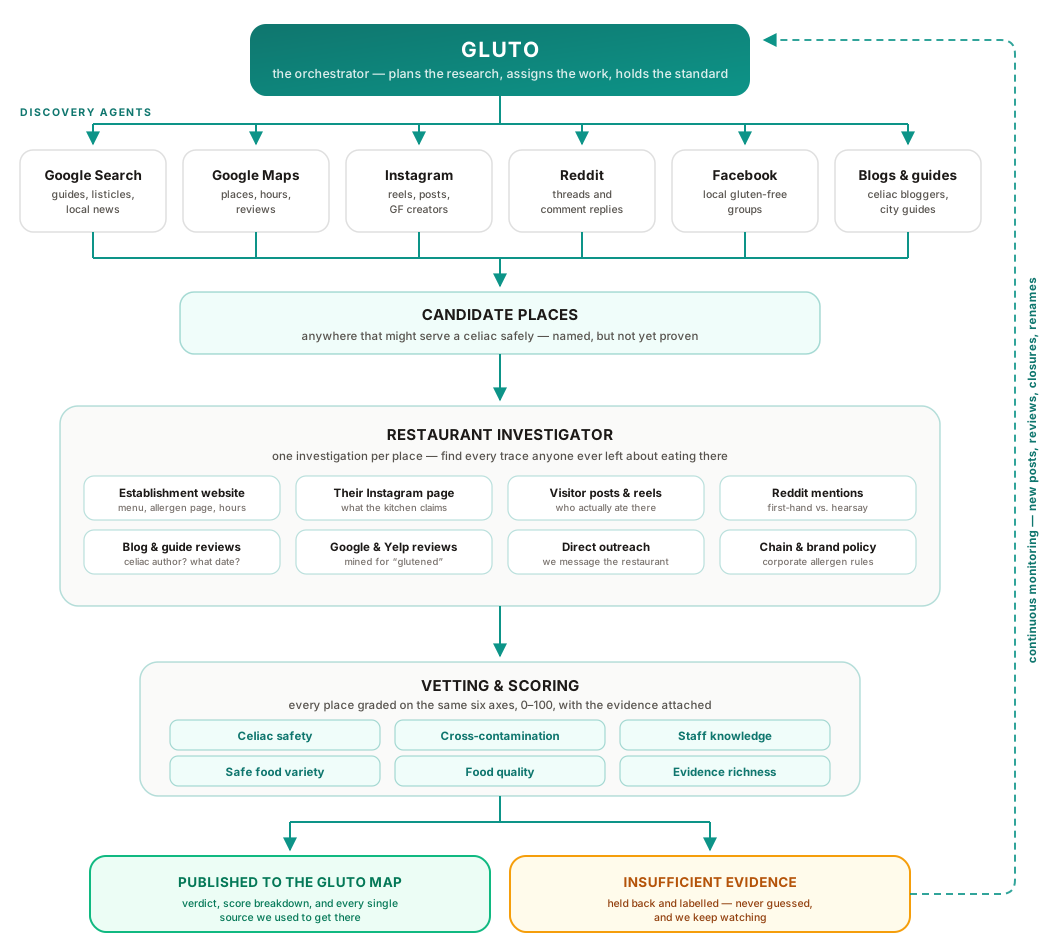
Gluto, the orchestrator
The main agent owns the question and the standard. It decides what needs researching — a city, a neighbourhood, a specific restaurant somebody asked about — breaks that into assignments, dispatches the specialists, and decides at the end whether what came back is actually good enough to publish. It is the part of the system that plays the role you played at eleven at night, except it is not tired and it never decides that four sources is probably fine.
The discovery agents
Six specialists go looking for places that might be safe, each fluent in the particular dialect of its own platform. The Google Search agent works the guides, listicles and local news. The Maps agent pulls places, hours, addresses and review bodies. The Instagram agent reads the reels and posts — including the visual content, which is the point. The Reddit agent works threads and the comment trees underneath, which is where the real answers live. The Facebook agent covers the local gluten-free groups. The blogs agent reads the celiac bloggers and city guides properly, including the comment sections, which is where a rename gets confirmed four years late.
What comes out is not an answer. It is a pile of candidates: everywhere that might conceivably serve a celiac safely, named but entirely unproven. This is roughly the pile you had after your forty tabs — except it is far bigger, and nobody had to spend a Friday night building it.
The restaurant investigator
Then the real work starts, and this is the agent that does what you were doing in step five and step six of the manual method.
For each candidate, an investigation opens with one goal: find every trace that anyone, anywhere, ever left about eating gluten-free at this specific place. It reads the restaurant's own website, menu and allergen page. It reads their Instagram, because what a kitchen chooses to claim about itself is evidence too. It hunts for posts and reels by people who actually ate there. It finds Reddit mentions and works out whether each one is first-hand or hearsay. It pulls blog reviews and asks who wrote them and when. It mines Google and Yelp reviews specifically for the language celiacs use — celiac, gluten, glutened, cross-contamination. For chains, it pulls corporate allergen policy, which sets a floor across every branch.
And when the public record leaves a question open, it does what Margaret did when she emailed Buddy's Pizza to ask whether the separate prep space was still real: it contacts the restaurant directly. The difference is that it can do this for hundreds of thousands of restaurants, and it keeps the question open and tracked until an answer actually arrives.
Vetting, and a verdict that can say “no”
All that evidence gets graded on the same six axes for every place: overall celiac safety, cross-contamination control, staff knowledge, how much you can actually order, whether the food is any good, and — importantly — how much evidence we have at all.
That last axis is the one most products would leave out. It is the difference between “this place is risky” and “we do not know enough about this place yet,” and conflating those two is exactly how someone gets hurt. A place that clears the bar goes onto the map with its verdict, its scores and its sources. A place that does not clear it is labelled insufficient evidence and held — not quietly guessed at, not padded out into a plausible-sounding paragraph.
The output is a knowledge graph, not a list
This is the part that matters most, and it is the direct answer to the Renee's problem.
A list says: Tru Pizza — safe. That is a claim you either trust or you do not, which puts you right back where you started.
A knowledge graph says something much more useful. This place — known by these names, at this address, part of this brand — has these dozens of pieces of evidence attached to it. Each piece of evidence carries who said it, when they said it, which platform it came from, whether they have celiac disease or avoid gluten by choice, whether they ate there or heard about it, and what specific claim they actually made. A dedicated fryer. A shared toaster. A separate prep bag with its own knife and board. A reaction.
Three consequences fall out of building it that way:
- Names resolve to one node. Renee's Gourmet Pizzeria and Tru Pizza are the same kitchen, so all the evidence attached to both names lands in the same place. That problem gets solved once, structurally, for everyone — instead of being re-solved by every traveler who is lucky enough to scroll far enough into a comment thread.
- Contradictions survive. When four people say a place is fine and one says they got sick there in March, we do not average that into a number. Conflict is information, and it is exactly the information a celiac needs to see before deciding.
- We can show our work. Because every verdict is built from cited, dated, attributed evidence, we can hand you the reasoning instead of asking for your trust. You should not trust a machine about this. You should be able to check it.
What that actually looks like
Back to Detroit. Same city, same Friday night. Here it is as a map.
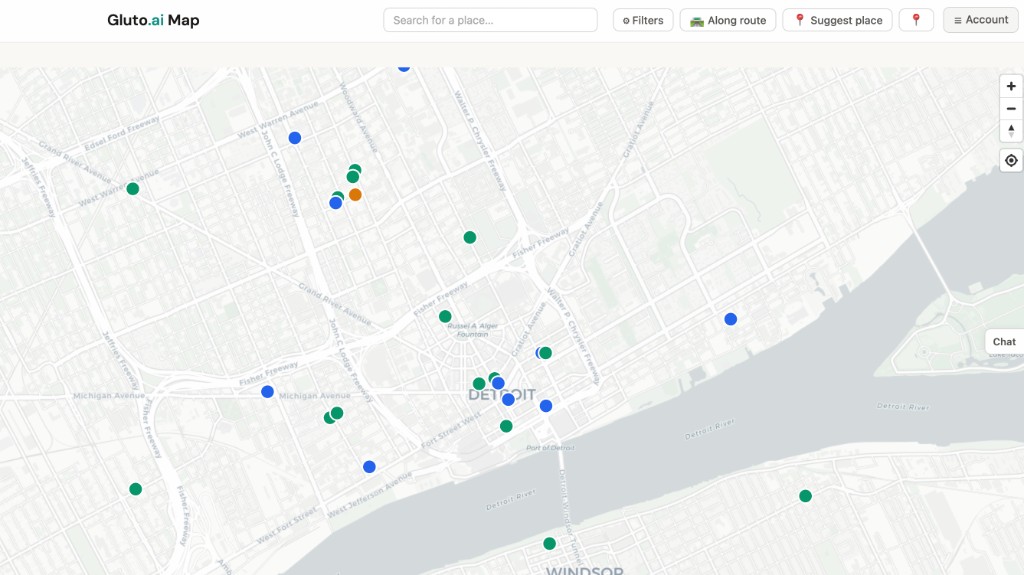
Now open one. Here is a place in the Detroit metro, on the same evidence trail we were following by hand earlier.
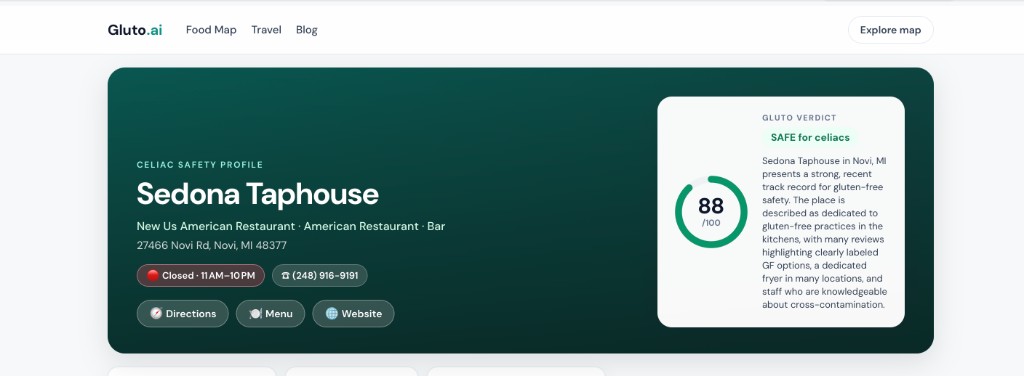
Read the verdict text closely and you can see the graph showing through: a recent track record, reviews highlighting clearly labelled options, a dedicated fryer in many locations, staff described as knowledgeable about cross-contamination. Note the hedge in “many locations” — that is deliberate, and it is the kind of qualifier a marketing page would sand off.
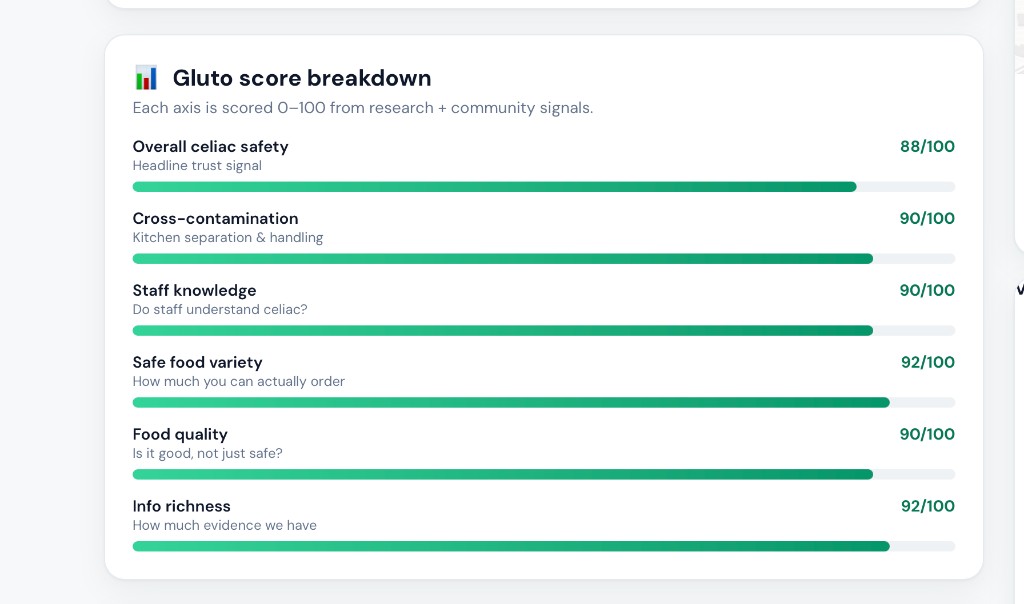
And then the part that took you an hour per restaurant by hand — what you can actually order, and what could go wrong.
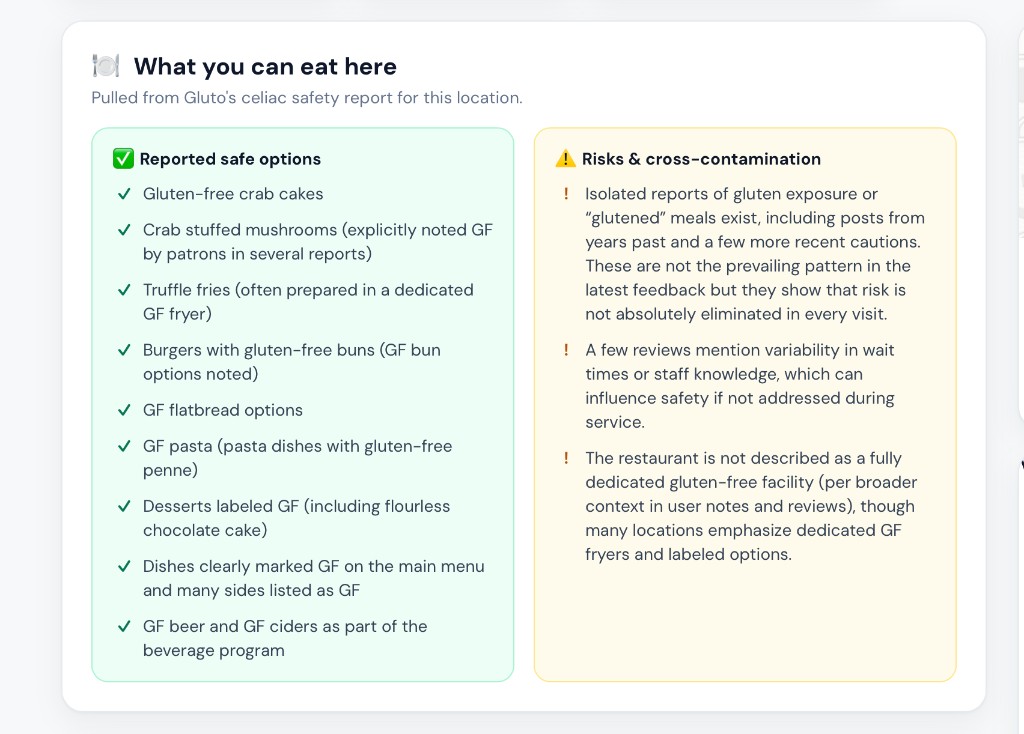
That right-hand column is the one we would ask you to judge us on. It says there are isolated reports of people being glutened, including some recent ones. It says staff knowledge varies. It says plainly that this is not a fully dedicated gluten-free facility. None of that helps us sell anything. All of it is what you would want a friend with celiac disease to tell you before you booked.
And underneath, the community evidence itself — not summarised away, but shown, with the creators credited and linkable.
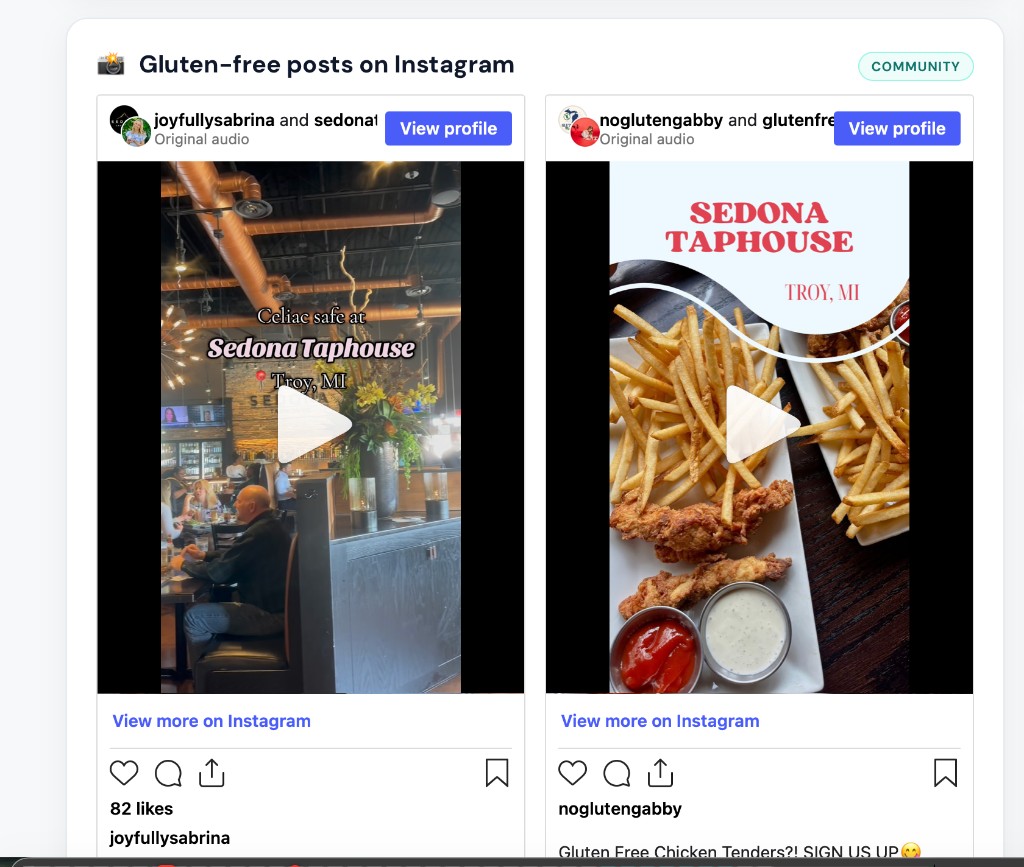
Now here is the detail that closes the loop on the whole article. Remember Margaret's comment section — the eighteen replies underneath her Detroit guide? One of them, from February 2024, reads: “I've eaten at Sedona Taphouse without any issues. I went to the Troy location.”
One sentence, from one person, buried fourteen comments deep on one blog. On its own it proves very little. But sitting alongside creator reels filmed at that same restaurant, review text mined for reaction reports, the chain's own allergen posture and a dedicated-fryer claim corroborated across locations, it stops being an anecdote and becomes a data point in a structure. That is the entire thesis of Gluto in one line of a four-year-old comment thread. Nothing new had to be discovered. It had to be found, read, dated, weighed and connected to everything else.
If you want to see one place taken apart in far more detail — verification sources, place photos, the full celiac safety report — we did a slow walkthrough of exactly that in how Gluto Map turns pins into proof.
Done once, for everywhere
The reason to build it this way is that the work does not have to be repeated. Every hour spent on Detroit is an hour nobody with celiac disease has to spend on Detroit again.
We would gently point at the gap between the second number and the third. Roughly four hundred and thirty thousand places were looked at and did not end up recommended as celiac-safe. In a category where the incentive is always to have the biggest directory, the restraint is the product. A map that says yes to everything is just a map of restaurants.
And then it never stops
Freshness is the hardest problem in this entire domain, and it is the one that quietly defeats even excellent human work. Sarah's Detroit guide was meticulous in 2020. Nothing about the page changed as it aged; it simply became less true, silently, while continuing to look authoritative. Margaret's rename note sat in a comment for four years. There is no mechanism anywhere in the community for a fact to get re-checked.
So the loop on the right-hand side of that diagram is not decoration. It is the reason the rest of it is worth anything. The system keeps watching for new posts and reels, new reviews, fresh reaction reports, menu changes, ownership changes, closures — and renames, which is precisely the failure mode that would have cost you the best pizzeria in metro Detroit. A cluster of new “I got glutened here” reports is treated as what it is: a signal to re-open the investigation, not noise to be averaged away.
Our team watches this too. Some things still need a human — a report that does not fit the pattern, a restaurant that gives an answer worth chasing, a city where the community is telling us something the data has not caught up with yet.
What Gluto is not
We would rather say this plainly than have you discover it later.
- It is not a guarantee, and it is not medical advice. Kitchens change between our last check and your reservation. Nothing on a screen can promise you a safe meal.
- It will still tell you to ask. Say the word celiac at the table, every time. The best possible outcome of our research is that you walk in already knowing which two questions actually matter at that specific restaurant.
- It says “I don't know” on purpose. Insufficient evidence is a real verdict in our system, and we would rather show you a gap than a confident sentence we cannot support. In this category, a fluent wrong answer is the most dangerous thing you could ship.
- It does not replace the people in the first half of this article. Margaret, Sarah, the strangers on r/Detroit, the creators filming reels, the seven thousand people in that Facebook group — they are the source. They always were. We cite them, link them, and send you to them. If Gluto is useful, it is because they did the hard part first.
Back to Friday night
Your flight still lands at six. Your friends are still sending links to the pizza place.
The difference is that the six hours already happened. Not by you, at eleven at night, on your third attempt to work out whether Renee's still exists — but once, by a system that read everything, kept what it learned, checks whether it is still true, and shows you where every claim came from so you can disagree with it.
You will still ask questions at the table. You should. But you get to start from evidence instead of from zero, and you get to spend the evening on the concert instead of the research.
And if you eat somewhere safe this weekend and write down what happened — a review, a post, a comment under someone's blog — that becomes evidence for the next person who lands in your city. Which is how this always worked. We just finally built the thing that remembers.
Credit where it is due. The screenshots above are shown for commentary, and every one of them represents work that someone in the celiac community did for free so that a stranger would not get sick. Please go read the originals and give them your traffic:
- Gluten Free Detroit Dining Options — Margaret Clegg, MI Gluten Free Gal
- Gluten Free Detroit Guide — Sarah Bence, Endless Distances
- 7 Best Gluten Free Restaurants in Detroit — Visit Detroit
- r/Detroit: Gluten free foodies · Best restaurants with gluten-free & dairy-free options · Gluten Free Dining
- Gluten-free restaurants in Detroit on Instagram
- Gluten Free in Metro Detroit — Facebook group
⚠ Important: This article is educational and is not medical advice. Celiac disease should be diagnosed and managed with a qualified clinician, and dining decisions should always be confirmed directly with the restaurant.